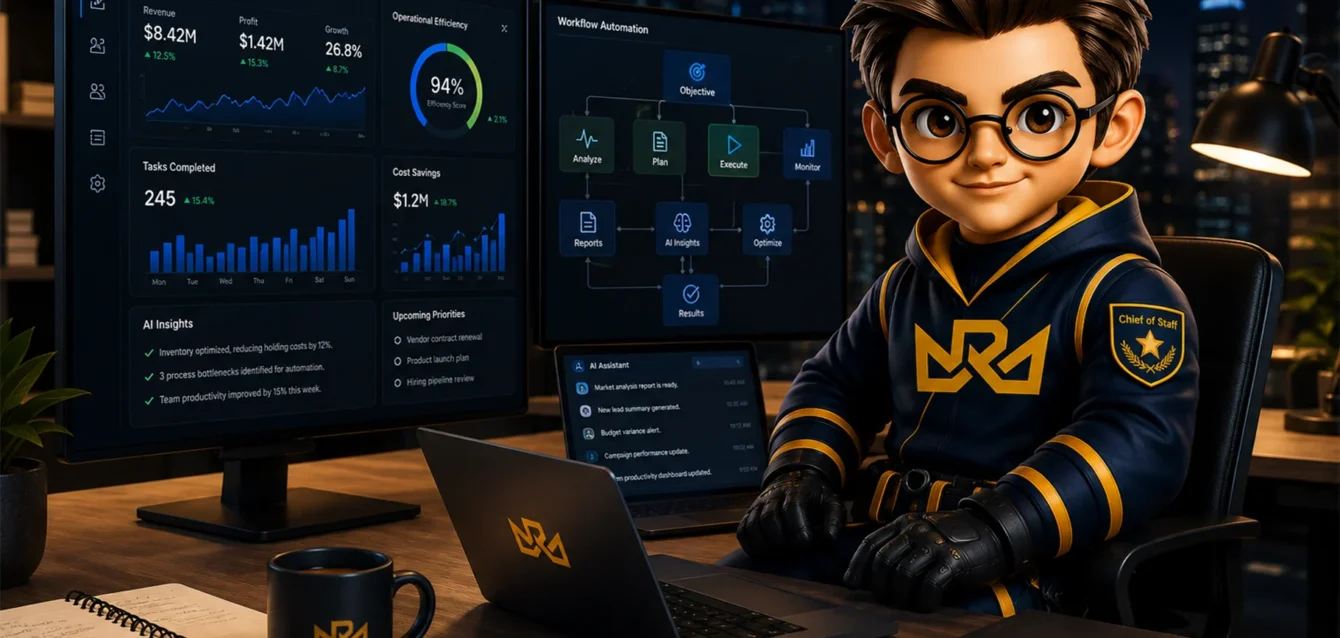
Businesses today are overloaded with operational work. Teams spend countless hours managing tasks, updating systems, tracking workflows, following up with stakeholders, organizing projects, and ensuring daily operations continue smoothly.
As organizations grow, operational complexity increases rapidly. Managing workflows across multiple tools, departments, and communication channels becomes difficult, especially for startups and fast-scaling businesses.
This is why companies are beginning to adopt AI Chief of Staff systems to streamline operations and improve execution. A modern AI operations manager can coordinate workflows, automate repetitive business processes, oversee task execution, and help organizations operate more efficiently.
Instead of relying solely on disconnected automation tools or manual coordination, businesses are now using AI business automation systems that function as operational leadership layers within the organization.
What Is an AI Chief of Staff?
An AI Chief of Staff is an AI-powered operational system designed to coordinate workflows, manage execution, organize priorities, and oversee business operations across teams and platforms.
Unlike a traditional chatbot or AI assistant, an AI Chief of Staff focuses on operational orchestration rather than simple task support.
It acts similarly to a real Chief of Staff by:
- Coordinating operational workflows
- Delegating tasks
- Managing execution
- Tracking priorities
- Monitoring business activities
- Improving operational efficiency
A modern AI operations manager can also coordinate AI Employees that handle repetitive operational tasks across multiple business functions.
Businesses adopting AI workforce platforms are increasingly using AI Chief of Staff systems to centralize operational management and reduce workflow inefficiencies.
Why Businesses Need an AI Operations Manager
Most businesses struggle with fragmented operations. Teams often manage tasks across multiple tools, spreadsheets, communication platforms, and disconnected workflows.
Employees spend significant time:
- Managing follow-ups
- Updating CRMs
- Tracking project progress
- Sending reminders
- Coordinating approvals
- Organizing operational tasks
- Monitoring workflows
- Managing internal communication
This creates operational overload.
An AI operations manager helps businesses reduce this burden by automating workflow coordination and operational management. Instead of manually supervising every process, organizations can use AI-driven business automation to continuously streamline execution.
As businesses scale, an AI operations manager becomes increasingly valuable for maintaining operational consistency and execution speed.
How an AI Chief of Staff Runs Business Operations
An AI Chief of Staff acts as the operational coordination layer between:
- Teams
- Workflows
- SaaS platforms
- AI Employees
- Operational systems
It continuously manages and organizes business execution across the company.
Workflow Coordination
An AI Chief of Staff can coordinate workflows across departments and ensure operational tasks move efficiently through the organization.
For example, it can:
- Assign tasks automatically
- Trigger workflow actions
- Monitor project progress
- Send operational reminders
- Escalate pending approvals
- Organize execution timelines
A modern AI operations manager reduces the need for constant manual oversight of workflows.
Task Delegation
One of the biggest advantages of AI business automation is intelligent task delegation.
An AI Chief of Staff can delegate operational work to specialized AI Employees, such as:
- AI Sales Employees
- AI Marketing Employees
- AI Support Employees
- AI Operations Specialists
- AI Administrative Coordinators
The AI operations manager oversees these AI Employees and ensures that workflows continue to run efficiently.
Operational Monitoring
Businesses often struggle to maintain visibility across their ongoing operations.
An AI operations manager can:
- Track execution progress
- Monitor workflow completion
- Generate operational summaries
- Identify bottlenecks
- Send status updates automatically
This improves operational transparency and reduces delays caused by manual coordination.
Cross-Platform Execution
Modern businesses use multiple SaaS tools daily. Switching between systems creates operational inefficiencies.
An AI Chief of Staff can coordinate actions across:
- CRM systems
- Project management platforms
- Communication tools
- Marketing software
- Internal operational systems
Instead of manually managing workflows across applications, businesses can centralize operational execution through AI business automation.
AI Chief of Staff vs AI Executive Assistant
Many businesses confuse AI executive assistants with AI Chief of Staff systems, but they serve very different purposes.
An AI executive assistant primarily supports individual productivity through:
- Calendar management
- Scheduling
- Email drafting
- Meeting reminders
- Administrative assistance
An AI Chief of Staff functions at the organizational level.
It focuses on:
- Operational management
- Workflow coordination
- Task orchestration
- Business process automation
- Team execution
- Cross-functional operations
In simple terms:
- An AI executive assistant helps a person stay organized.
- An AI Chief of Staff helps the business itself operate efficiently.
This distinction is becoming increasingly important as companies adopt AI operations manager systems for large-scale operational coordination.
The Role of AI Employees in Business Operations
An AI Chief of Staff becomes significantly more powerful when connected to AI Employees.
AI Employees are specialized operational AI systems designed to automate business tasks.
For example:
AI Sales Employees
Can manage:
- Lead follow-ups
- CRM updates
- Sales pipeline organization
- Reporting workflows
AI Marketing Employees
Can handle:
- Content coordination
- Campaign management
- SEO workflows
- Analytics reporting
AI Operations Employees
Can support:
- Workflow execution
- Internal coordination
- Process automation
- Operational tracking
The AI operations manager coordinates these AI Employees together as part of a centralized AI workforce.
If you want to understand how AI Employees function within modern businesses, read our guide on What Is an AI Workforce?
Benefits of Using an AI Operations Manager
Businesses adopting AI operations manager platforms are seeing major improvements in operational efficiency.
- Reduced Operational Overload – Teams spend less time manually managing repetitive coordination tasks.
- Faster Execution – AI-powered workflows continue operating without delays caused by manual supervision.
- Better Workflow Visibility – Businesses gain centralized visibility into operational activities, execution status, and workflow performance.
- Improved Scalability – An AI operations manager helps organizations scale operations without dramatically increasing operational complexity.
- Enhanced Productivity – Employees can focus more on strategy, growth, creativity, and decision-making rather than on repetitive operational management.
Industries Using AI Business Automation
AI business automation is expanding rapidly across industries because operational coordination exists in nearly every organization.
Startups
Startups use AI operations manager systems to scale efficiently without hiring large operational teams.
Agencies
Agencies automate:
- Client workflows
- Campaign coordination
- Reporting systems
- Internal execution management
SaaS Companies
Software businesses streamline:
- Customer operations
- CRM workflows
- Support coordination
- Team management
E-commerce Businesses
Online businesses automate:
- Customer communication
- Inventory workflows
- Operational tracking
- Marketing coordination
Enterprise Teams
Large organizations use AI business automation systems to reduce administrative overhead and improve workflow efficiency.
The Future of AI Business Automation
The future of business operations is shifting toward AI-driven operational management.
Instead of relying on disconnected tools and manual coordination, organizations are beginning to adopt centralized operational AI systems that can:
- Coordinate workflows
- Delegate tasks
- Execute repetitive operations
- Manage operational priorities
- Oversee AI Employees
- Streamline execution
This transformation is creating a new operational model in which AI Chief of Staff platforms function as the business’s operational control center.
Platforms like RangerOS are helping businesses move toward this future by combining AI Employees, AI workforce coordination, workflow orchestration, and AI business automation within a unified platform.
As AI systems continue evolving, businesses that adopt AI operations manager platforms early may gain advantages in:
- operational efficiency,
- scalability,
- execution speed,
- and workforce productivity.
Final Thoughts
An AI Chief of Staff is becoming one of the most important operational technologies for modern businesses. Companies are no longer using AI only for assistance; they are now adopting AI-driven operational systems that can coordinate workflows, manage execution, and streamline business operations at scale.
As operational complexity continues growing, businesses need systems that can intelligently manage workflows across teams, platforms, and operational processes.
An AI operations manager helps organizations reduce operational overload, improve execution visibility, automate repetitive coordination, and support scalable business growth.
Companies that combine human leadership with AI business automation will be better positioned to operate efficiently in the future of work.
FAQs
Q1. What is an AI Chief of Staff?
An AI Chief of Staff is an AI-powered operational system that coordinates workflows, manages execution, and oversees business operations across teams and tools.
Q2. What does an AI operations manager do?
An AI operations manager automates workflow coordination, tracks operational execution, manages tasks, and streamlines business processes.
Q3. How is an AI Chief of Staff different from an AI executive assistant?
An AI executive assistant supports individual productivity, while an AI Chief of Staff manages operational workflows across the entire business.
Q4. Can AI business automation improve productivity?
Yes. AI business automation reduces repetitive operational work, improves workflow efficiency, and helps teams focus on higher-value activities.
Q5. Which businesses can benefit from AI operations management?
Startups, agencies, SaaS companies, e-commerce brands, and enterprises can all benefit from AI-driven operational management systems.