The Future of Autonomous Business Operations
Businesses today operate through dozens of disconnected tools, repetitive workflows, fragmented communication systems, and manual operational processes. As companies grow, managing operations across sales, billing, content, customer support, and internal coordination becomes increasingly difficult.
An AI workforce platform is a system that uses specialized AI workers to manage, automate, coordinate, and execute business operations across multiple functions. Unlike traditional automation tools that focus on isolated tasks, AI workforce platforms operate as interconnected operational systems that handle workflows end-to-end.
As businesses move toward autonomous operations, AI workforce platforms are becoming the foundation of modern operational management.
Understanding an AI Workforce Platform
An AI workforce platform functions similarly to a digital operational team. Instead of relying entirely on human coordination or disconnected automation tools, businesses can use specialized AI systems designed to handle operational responsibilities automatically.
These platforms typically include:
- AI operational managers
- Workflow orchestration systems
- AI specialists
- Delegation systems
- Automation layers
- Operational monitoring systems
Together, these components create an AI-powered workforce capable of coordinating business activities across multiple departments and workflows.
Unlike standard AI assistants that respond to prompts individually, AI workforce platforms continuously manage operational execution.
How an AI Workforce Platform Works
AI workforce platforms are designed to organize operational workflows across different business functions while minimizing manual coordination.
The process generally works through several operational layers.
Workflow Planning
The platform analyzes tasks, business priorities, operational goals, and ongoing workflows to automatically structure execution processes.
AI Task Delegation
Tasks are assigned to specialized AI workers based on operational requirements. For example, billing-related tasks may be delegated to billing specialists, while content workflows may be delegated to content-focused AI systems.
Workflow Coordination
The system monitors workflow execution, manages operational dependencies, and ensures tasks move through the pipeline efficiently.
Businesses increasingly use systems such as an AI Chief of Staff to coordinate AI specialists across operational workflows and to automate execution processes.
Operational Execution
AI workforce platforms can automate:
- Customer follow-ups
- Invoicing workflows
- Reporting
- Scheduling
- Task management
- Operational coordination
- Workflow tracking
- Business communications
Continuous Optimization
As workflows evolve, AI systems can identify inefficiencies, repetitive processes, and operational bottlenecks to improve execution over time.
This creates a scalable operational model for growing businesses.
AI Workforce Platform vs Traditional Automation Tools
Many businesses confuse AI workforce platforms with workflow automation tools, but the two operate very differently.
|
Traditional Automation Tools |
AI Workforce Platforms |
| Automate isolated tasks | Coordinate operational systems |
| Rule-based workflows | Intelligent workflow orchestration |
| Require manual supervision | Manage execution autonomously |
| Focus on triggers and actions | Focus on operational management |
| Limited contextual understanding | Adaptive operational coordination |
Traditional automation tools help businesses automate repetitive actions. AI workforce platforms help businesses automate operational management itself.
This distinction is becoming increasingly important as AI systems evolve beyond simple workflow automation.
AI Workforce Platform vs AI Assistants
AI assistants and AI workforce platforms also serve different purposes.
|
AI Assistants |
AI Workforce Platforms |
| Respond to prompts | Coordinate operational workflows |
| Handle individual requests | Manage business operations |
| Operate reactively | Operate proactively |
| Focus on user productivity | Focus on operational execution |
| Limited workflow ownership | End-to-end operational management |
An AI assistant helps complete tasks. An AI workforce platform helps run business operations. This operational difference is one of the biggest shifts happening in modern AI software.
Components of an AI Workforce Platform
AI workforce platforms rely on multiple interconnected systems working together to automate operational execution.
AI Chief of Staff
An AI Chief of Staff serves as the central operational coordinator, responsible for workflow planning, delegation, monitoring, and execution.
Businesses adopting autonomous operational systems are increasingly implementing AI Chiefs of Staff to coordinate AI-powered workflows across departments. Learn more about what an AI Chief of Staff is and how AI-powered operational systems manage business execution.
AI Specialists
AI specialists are dedicated AI workers designed for specific operational functions such as:
- Sales management
- Billing operations
- Social media management
- Content workflows
- Operational coordination
These specialized systems improve execution quality by focusing on defined operational responsibilities.
Workflow Orchestration
Workflow orchestration systems coordinate task execution across different workflows, tools, departments, and AI systems. This operational layer helps businesses automate coordination rather than simply automate isolated actions.
Operational Monitoring
AI workforce platforms continuously monitor workflow progress, operational bottlenecks, execution status, and business processes to ensure tasks are completed efficiently.
Why Businesses Are Adopting AI Workforce Platforms
Modern businesses face increasing operational complexity due to:
- Remote work
- Fragmented software stacks
- Growing administrative workloads
- Repetitive operational coordination
- Increasing customer communication demands
AI workforce platforms help businesses reduce operational overhead while improving workflow scalability and execution speed.
Benefits of an AI Workforce Platform
- Reduced Manual Coordination – Businesses spend less time on repetitive operational tasks and on delegating manual workflows.
- Faster Operational Execution – AI systems can continuously coordinate workflows, reducing delays caused by manual management processes.
- Improved Scalability – Operational systems can grow without requiring proportional increases in administrative overhead.
- Better Workflow Visibility – Businesses gain centralized visibility into workflows, operational progress, and execution pipelines.
- Operational Efficiency – AI-powered coordination systems help eliminate bottlenecks, repetitive processes, and fragmented operational management.
Common Use Cases for AI Workforce Platforms
AI workforce platforms can support operational workflows across multiple industries and business models.
- Freelancers – Managing client onboarding, invoicing, content workflows, scheduling, and follow-ups through centralized operational automation.
- Solopreneurs – Coordinating sales, marketing, support, content, and administrative workflows without building large operational teams.
- Agencies – Managing campaigns, task delegation, reporting workflows, client communication, and operational coordination.
- SaaS Startups – Automating operational execution while internal teams focus on product development and strategic growth.
- E-commerce Businesses – Handling inventory coordination, support workflows, operational reporting, customer communication, and recurring business processes.
The Rise of Autonomous Business Operations
Businesses are increasingly shifting from isolated automation tools toward autonomous operational systems capable of managing execution end-to-end.
This shift includes:
- AI workflow orchestration
- Intelligent task delegation
- Operational automation
- AI specialists
- AI-powered coordination systems
As AI systems become more advanced, operational management itself is becoming increasingly automated.
Businesses exploring autonomous operational systems are also adopting AI-powered workflow coordination strategies to automate execution across multiple functions. Learn more about how AI Chief of Staff systems run business operations.
How RangerOS Functions as an AI Workforce Platform
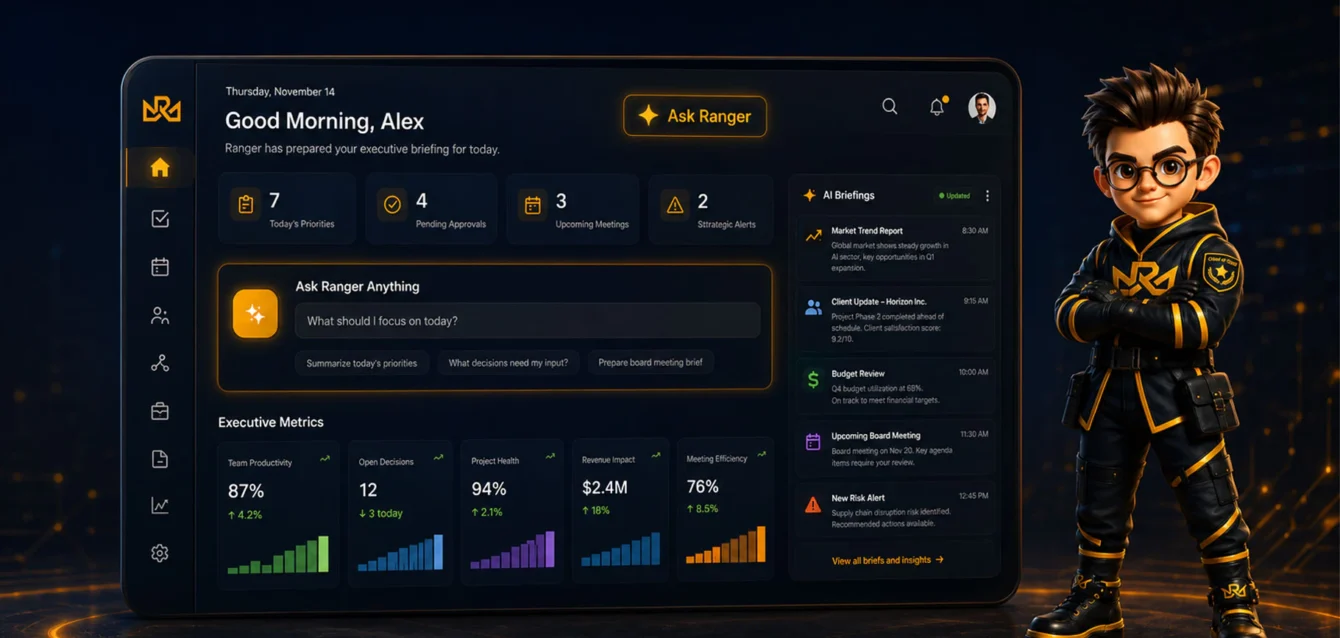
RangerOS is an AI-powered Chief of Staff platform designed for freelancers, solopreneurs, and growing businesses. It manages business operations end-to-end by planning workflows, assigning tasks to AI specialists, and automatically executing work.
Instead of functioning as a simple AI assistant, RangerOS serves as an AI workforce platform in which specialized AI employees coordinate workflows across sales, billing, content, support, and operational management.
This allows businesses to automate execution rather than only automate individual tasks.
The Future of AI Workforce Systems
AI workforce platforms represent the next evolution of operational software.
Instead of relying entirely on disconnected tools and manual workflow management, businesses are moving toward AI-powered systems capable of:
- Coordinating workflows
- Delegating operational tasks
- Managing execution pipelines
- Automating operational decisions
- Scaling business operations autonomously
As autonomous business operations continue evolving, AI workforce platforms are expected to become a central operational layer for modern companies.
FAQs
Q1. What is an AI workforce platform?
An AI workforce platform is a system that uses specialized AI workers to manage, automate, coordinate, and execute operational workflows across business functions.
Q2. How does an AI workforce platform work?
AI workforce platforms use AI specialists, workflow orchestration systems, and operational coordination layers to automate end-to-end business operations.
Q3. What is the difference between AI automation and AI workforce platforms?
AI automation tools automate isolated tasks, while AI workforce platforms coordinate operational workflows across multiple functions and systems.
Q4. What are AI specialists?
AI specialists are dedicated to designing AI systems that handle specific operational functions, such as sales, billing, support, content creation, or workflow management.
Q5. Can AI workforce platforms replace operational teams?
AI workforce platforms can automate many repetitive operational processes, reduce coordination overhead, and support business scalability, but human oversight remains important for strategy and decision-making.
Final Thoughts
AI workforce platforms are transforming how businesses manage operations, workflows, delegation, and execution.
Rather than relying solely on fragmented automation tools or manual coordination, businesses are increasingly adopting AI-powered operational systems that handle workflows autonomously.
As autonomous business operations continue growing, AI workforce platforms will likely become a foundational layer of modern business infrastructure.